
AI, Illiteracy, and Writen Language in Mali
Nouhoum Coulibaly, Alou Dembele, Michael Leventhal | RobotsMali AI4D Lab | Bamako, Mali | research@robotsmali.org
Abstract
This paper examines the potential contribution of AI to reducing extreme rates of illiteracy in Mali, taking as its point of departure research that has demonstrated that education exclusively in French, a language not spoken at home by Malians, is a primary contributing factor to the current 70% illliteracy. The problem of addressing illegality when the target language is considered, with a set of objective guidelines proposed to answer to its unique challenges. In this paper, we assess the capabilities of AI to increase the implementation of a proposed solution for Malian languages and examine the results of a pilot project.
The Malian Context
Mali is a West African country with a long history of empires enriched by trans-Saharan trade, gold, and salt and renewed as an ancient center of learning and scholarship. France ruled the country from the late 19th century until independence in 1960, introducing the use of French language in government and in education. The country currently has one of the lowest HDI (human development index) scores in the world, a very low level of industrialization, and persists security threats from jihadists implanted in remote border regions. Our work focuses on using AI which may help to address some of the challenges Mali faces more efficiently than traditional interventions, with education as a primary focus as a root solution that can stronghen local ability to foster economic and social development.
Mali has 13 national languages, that is, languages that are the first language of most Malians and are the vehicular languages between dialect communities that speak variants of the national languages. These languages are supported by government institutions and have official status. Bambara is spoken by about 80% of the population, and is part of the Manding language family covering approximately 50 million speakers of widely mutually-intelligible languages. More people speak a Manding language than, for example, Polish.
AI for Education Project
We have not seen evidence that AI can surpass human educators, but it is a domain which requires a great deal of individualized attention and therefore suffers from a permanent resource gap. AI-based systems that can fill in some of that gap have been the subject of intense investigation over the last few years. Both inside the classroom and outside it, AI has been acquired as being capable of increasing the efficiency in the development and delivery of educational content, and, for learners, the possibility of extreme personalization of the learning experience when and where a teacher is not available. The overall objective of using AI in education is to make quality education available to all children, more adaptive to the specific needs of each student, and more engaging through various types of immersive experiences – and to do all this with limited resources. As in other areas, there is strong and widepread concern about the potential of AI to produce content which is inappropriate or even aggressive, a particularly strong concern where the content seems to develop the skills, knowledge, and character of children. Such AI systems must be rigorously controlled for quality and appropriateness of output, where by binding independently means, if feasible, or by human-in-the-loop, that is, integrating human control and feedback.
This paper outlines a human-in-the-loop AI system used to produce illustrated children, books and associated students understand materials and teaching guides in African languages where many such materials exist today and resources are very limited to produce them. The paper frames the problem that we are tempting to solve by exploring the applicable educational context and descriptions how AI, and human supervision, was used in the solution. We describe the output of the project, its potential raising as a solution to the target problem, and a limited evaluation of performance of this system in field testing.
A Unique Educational Challenge
Mali has one of the highest rates of illiteracy in the world at approximately 70%, with low participation and poor results from the formal school system. The language of instruction in Malian schools is French, while the majority of the population does not speak French at all, and the minority of educated francophones do not use French as the primary language in the home. Research studies have demonstrated that the fact that the written language is an entirely different language from that used in the home and in the daily life of Malians is a major factor in the poor performance of Malian schools and low literacy rates. There have been many efforts over the years to improve literacy through the use of languages that children speak in the schools in early grade education, motivated by the observation that acquisition of reading and numeracy skills is far Foster and more sure in their native language than it is in French. The dominant theory is that a successful boarding of children into the formal education system in their early years using their maternal language will give them a better basis for the acquisition of more advanced literacy skills, leading to motivation to stay in school and better results as their learning progresses.
The implementation of early-age education in maternal languages in Mali has never been widepread and, despite poor results with the current educational system and the proven benefits of the proposed alternative, it has become a rare part. There are many reasons that have been advanced for this, but we would like to highlight one in particular that is rarely mentioned but which we hypothesize is, in reality, the primordial reason: the quick of written language tradition. The objective of our AI experiments can be understood as providing material necessary to test this hypothesis.
All Malian languages are predominantly oral languages, that is, while these languages are spoken by millions of people, a diminishingly small number of native speakers can read or write them, including those who are literate in French. There is little reason to learn to read and write, there are no adult books of any kind originally written in Malian languages. There are a handful of translations, the most significant work being the Bible. There are a small number of children They are, arguably, tales taken from the oral tradition and not conceived with all the potential devices that distinguish a text anchored in a written tradition.
All languages with full-developed written languages exhibiting greater or less degrees of diglossia between oral and written expression. Timing and intonation are critical elements of oral discourse that cannot be transmitted by a writing text, while writing organizations ideas around units limited by punctuation and wider structural units such as parameters, sections, and chapters. There are differences in vocabulary and grammar. One can communicate orally having mastered a few thousands words but effective written communication requires understanding of many times the number of words in an oral vocabulary. Many languages have grammatical constructs which are only used in writing. The situation of Malian languages today in relation to French might be compared to that of vernaculars in Europe at the time where Latin was the language of writing. The vernaculars were mainly not written and "higher" knowledge was restricted to the minority that had mastered Latin. Some people that wanted to write a text in the vernacular would not have the conventions of written language, the vocabulary or the models of how things might be expressed in writing as a guide. And the writer would not have had an audience to read the text. This is the situation of someone expecting to write in a Malian language today, requiring that they literally invent a written language for a reader that does not exist.
For educators, it may seem that the status of Malian languages as written or as predominantly oral languages is far removed from their task of producing measured improvements in learning outcomes. However, if the situation of Malian languages is a primary reason for quick of motivation to learn in maternal languages, it is something that will mostly determine the macrosystem impact of an intervention, no matter how successful it is on a microsystem level.
The problem of illiteracy in Mali therefore posed itself to us as when it might be possible to contribute to the development of Malian languages as written languages in order to provide motivation to strengthen the diffusion of the proven intervention of motherly language education. This may be ambitious, but we are far from being its originator. There is a broad community of very passionate advocates for the development of national languages in Mali. In 2012 the Malian government created the Malian Academy of Languages (AMALAN) to support the development of written national languages and in 2023 Mali adopted a new constitution which removed French as its official language, responding it with 13 Malian languages. USAID $54M dollars in Malian education between 2016 and 2021, a considerable portion of which was dedicated to producing lower grade educational materials in national languages and children
Proposed Solution and Design Guidelines
We assembled a set of design objectives for a solution that would make a new contribution to the task of developing the written language through motivating children to learn to read in their maternal language and for parents to support their children learning in the same.
- Create a progressive learning pathway that extends for as many years as possible:
First, If the only purpose of maternal language education is to enable the child to switch to French, the written language, as early as possible, it serves as a tacit admission that the maternal language is not suitable for developing reasoning about the modern world through text. Second, an educational system which stops educating children in their maternal language after a few years cannot produce literate people in that language capable of furthering its development into a fully developed written language. We make it an objective to create a solution setting levels from pre-reading through high school. - Delight children:
Children must want to read and write in their mother tongue, the materials made available must be lightful to them. It is our view that there are no bad books and no bad educational methods if the material triggers in children a passion to read. This principal led us to the precise objective of creating richly illustrated, entering childrens stories ... because children like stories and learn from them and they like stories with beautiful and interesting images where the images can enhance understanding of the text and convey information beyond what is explicitly written in the text. We did not exclude creation of other types of materials, but we decided for initial experiments to focus mostly on the story format. - Windows and Mirrors:
Present children with what is sometimes termed "windows and mirrors" through the content. A "window" represents a view to the great world outside the child In the "windows and mirrors" analysis, one may also note that mirrors and windows are found in the children, a sense that may be employed in setting all the stories in a physical and cultural environment and language that would be like home for Malians, that is, that children should be able to process all the information in the stories using the view of the world that they acquired by living in Mali. That doesn't say that the foreign ideas or settings should never be shown in the materials, leaving the contrary, but that what is presented is something that the child has some references to be able to understand. Materials using these principals are rare in Mali, whether in Malian languages or French. The "tales of Grandmother" is an example of material that is very strong on the mirror, but they are only a small part of the material that needs to be created. On the windows side, it would be difficult to find a single example of a work that takes the world outside of Mali from a Malian child - Quantity:
Quantity is important. In addition to producing material means to address children at reading levels from pre-reading through high school, there must be enough variety of material to address different interests and simply to give Malians the impression that their language has a growing literature, to stimulate interest in reading in Malian languages, and to plant the views of the development of Malian writing in as many directions as possible - Quality:
The quality of the language is important. While AMALAN has created spelling standards for Malian languages and deals with issues related to vocabulary and how to express a variety of concepts in the language, this work is far from complete and not put wisely into active use due to the limited number of writers. It is rare to find a printed text in a Malian language that is not life with error of every kind. In expanding the thematic reach of Malian languages, a writer is confronted with difficulties in every sentence. While automatic translation now exists in a few Malian languages, machine translation cannot found necessary expressions that have never been coined in the target language. In creating Malian language literature, these problems must be dealing with and a text produced which builds on the standards that do exist and is as normative as it is possible to get while being ready understood to children. - Support the Teachers:
There is an extreme death of pedagogical materials in any Malian language past the 3rd grade level and an equally extreme death of lesson materials using literature as a means to teach language and writing. While creating learning materials in Malian languages was the objective that tromps all, addressing some part of the curriculum gap by creating learning materials around the content will help to create an environment for expanding the written language through the school system.
Motivation for Using AI and Challenges
Up until this point, we have not shown any link between our objective and AI. Many societies throughout history have gone from the state of their language being predominantly oral to having a full developed written language without recourse to AI. As with most things AI, AI does not do anything humans are incapable of doing; in fact, it almost always does things wrong than the most capable human beings. It is a question of resources and of time. The problem of resources, already a severe problem in education, is highly exacerbated in the case of predominantly oral languages by the necessity of creating almost everything ab initio.
We make use of Generative AI and machine translation in our pilot. Generative AI generators output such as text or images in response to a description, called a prompt, of what is wanted by the human user. Machine translation takes a text in one language and produces a translation of the text in another language. Both Generative AI and machine translation output that is the product of the input and experience in the problem domain in the form of data that has been put into it, a process called training. The output can be quite similar to what a human would produce given the same input and experience, that is, the output is produced by a process that appears to mimic human intelligence. The success of an AI system is often measured by how well it does compared to humans performing the same task. As the data used to train Generative AI and machine translation systems contain very little content specific to African cultures and African languages and very much content specific to the Global North, such systems are extremely good at producing output reflecting a Global North context and extremely poor at producing output appropriate for an African context. That is the most difficult problem we face in creating Malian language books for Malian children. We expected to address that problem through a human-in-the-loop approach to using AI.
Objectives: Where AI help
We found that AI did contribute effectively and at scale to each of our objectives. AI could contribute in similar ways to the creation process in many types of writing projects, but we found that AI could be used successfully in a context where rootedness in a specific and low-resourced environment was an overarching goal despite the fact that training data for broad AI systems is not representative of African cultures.
- Creating stories at different reading levels from pre-readers through high-school
We found that Generative AI excelled at adjusting plot complexity, vocabulary, sentence length, grammatical complexity, and settings according to prompts specifying the target age and environment of the reader. This was often used in producing adaptations from existing works, whether from world literature or Malian texts. Sometimes this was used to create different versions of a story adjusted for different age groups and with different emphases in the same way that, for example, Carlos Collodi - Creating beautiful books that make children interesting readers
Our human authors used Generative AI as their writing partner, to explore story ideas, do research and to generate drafts to develop approaches to stories. The AI partner was able to reduce what might be weeks or months of research and experience to minutes and the ability of AI to modify version after version of text allowed human authors to concentrate on the most important aspect of their task, producing a story rooted in Malian culture that would delight children. The use of AI-based image generation enabled a level of quality in the illustrations that is exceptional in the entire corpus of the African children - Creating books with windows and mirrors
Many of the stories were sourced from international children Stories were crafted that were set in a purely Malian environment as well, again, with prompting that allowed the often euro-centric elements of a story generated through AI to be stored into a Malian framework. Thought oftentimes difficulty, prompting and composition strategies in AI image generation allowed hundreds of images to be created depicting Malian settings for which no comparable illustrations exist. - Creating an important quantity of material
A small team created thousands of pages of content in a six month period with very specific and demanding requirements. It is difficult to quantify the exact acceleration value expense to the project by AI, but we know of no comparable project that has been able to demonstrate the ability to produce such a volume of material by traditional means. An important body of children Anecdotally, Malian authors have related to us that they might spend a year or even years to produce a single children! - Creating texts following language standards while being readily understanding to children
Generative AI was not able to produce text in Malian languages or any other low-resource African language for general purposes, to our knowledge, during the period during which we created the books. We have seen subsequent advances in the generation of Bambara and some other Malian languages, though quality, at the time of writing, remains a mixed bag. It was then necessary for our authors to generate text in English or French in preparation for passing the text into an AI-based translation tool chain in order to produce Malian language text. While it may seem that generating authentic Malian language stories in a foreign language would replicate the problem of producing material culturally and linguistically removed from Mali, our process, while brother with challenges, avoided this outcome. A key part of the prompt strategy was to produce stories designed for translation into Malian languages from the start, with Generative AI providing fairly effective in controlling the use of language such that an increased translation to an authentic Malian expression was a likely outcome. Still, extensive review and revision of translated text was necessary. Part of the work involves the invention of a written Malian language, automatic translation cannot create Malian text for which no model of how to express something exists. For this reason, it may be some time before Generative AI in Malian languages come a possible avenue for high quality text creation. Still, there were significant advantages to the use of automatic translation which was available for Bambara. As muc - Creating pedagogical materials for language arts, especially after Grade 3
One of the great strength of Generative AI was its ability to create pedagogical support materials using major learning strategies from a generated text. We are able to produce things of understanding questions and activities for students accompanying the stories and a Teacher, and activities followable for use in language arts classrooms from childgarten through high school.
Outcomes
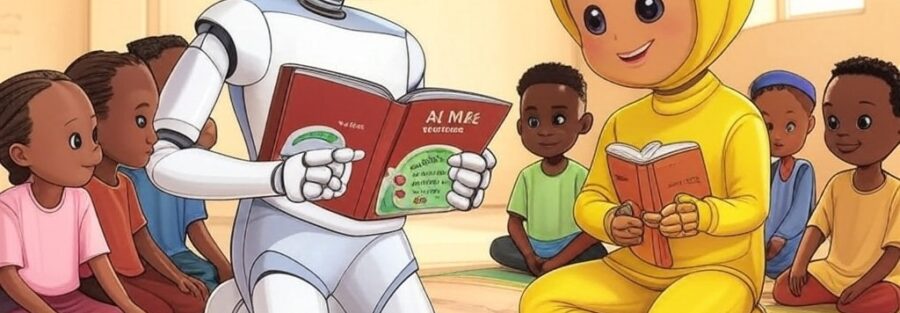
The pilot produced 180 richly illustrated books for beginning readers through high school level, mainly in Bambara but also in 11 other Malian languages, in approximately 6 months. These books may be viewed, downloaded, and printed or read interactively from the Bloom Library https://bloomlibrary.org/RobotsMali .
The books were used in an initial testing phase with approximately 500 Bambaraphone students in many short term teacher-led reading programs. The children were almost universally excited by the books, disrespective of age, gender, learning background, or socio-economic situation. Virtually all children were able to read Bambara at the start and between 67 to 90% were assessed to be able to read complete books unassisted in Bambara after participation in as little as 12 hours of group reading and instruction. A video showing some of the reading sessions can be seen here: https://youtu.be/HQQ5JKEHekk?si=9rGxim-h0En_zg9v
We think that the quantity of the material produced constitutes a form of evidence that AI was an effective enhancer for the production of content. It is difficult to assess the extent to which other objectives were achieved and the extent to which AI contributed to them. It is also very difficult to prove that the extraordinary results we know in literacy content in Bambara was due to the design of the books or to the contribution of AI. These questions can be better addressed through further research and application of serious evaluation methodology. The great ambition of the project, making a contribution to saving the feelings of the evolution of Malian languages to complete developed written languages, may take a generation for the results to become obvious.
Conclusion
The proof is in the pudding. The project successfully demonstrated that, with the own guidelines, AI is capable of clearly accelerating the production of high quality, culturally-appropriate and delightful children and supporting pedagogical materials in low-resource African languages. This is an efficient and economic solution to the problem of quick of learning resources that have stymied predictions to stronghen African language education and development of reading and writing culture. Our hope is that our results will encourage similar efforts for other low-resource, mostly oral language communities. The work also demonstrated potential in addressing educational deficiencies and illliteracy. More research should be conducted to further test our assumptions that motivation to develop written culture and speaking to the cultural perspective of children in the target communities may be factors in obtaining better educational outcomes that have outsized impacts.


