

Towards a Modern Children's Literature in Bambara: The GAIFE Collection
Authors: Nouhoum Souleymane COULIBALY | RobotsMali AI4D Lab, Bamako, Mali, research@robotsmali.org
In Mali Reading takes place in the Community's Sein
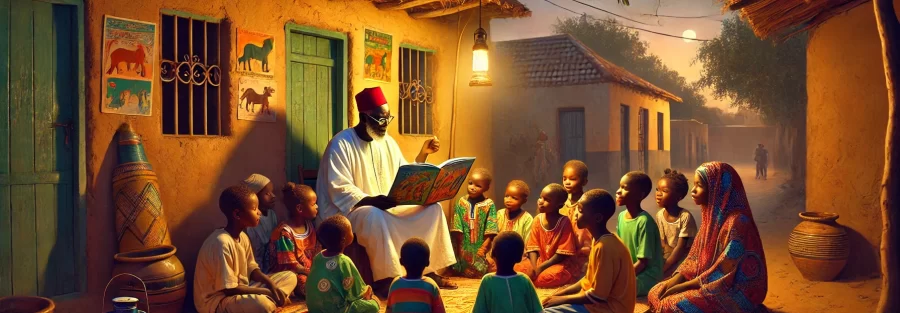
In the neighborhood Baco Djicoroni ACI in Bamako, Mr. Abdoulaye Coulibaly created a small reading club with the books of the youth collection in Bambara of GAIFE. Every evening, his house becomes a gathering point for children in the neighbourhood, eager to discover new stories.
“At first, I was just reading for my three children," Tells Mr. Coulibaly. “But quickly, the children of the neighbors began to come. Now, I regularly 8 to 10 children who meet for evening reading.”
Fatim, his seven-year-old daughter, Don't hide his enthusiasm: "I love the pictures of the book ‘Baganw" The animals are exactly like those I see in our yard. And when Dad reads, he makes the voices of the different characters!“
Mrs Dialloa neighbour whose children participate in the reading sessions observed a significant change: "My kids didn't talk much about bambara before. Now they use expressions they have learned in books. It's amazing how these stories connect them to their culture..”
Success is such that other parents in the neighborhood have started to get interested GAIFE books. Mr Coulibaly noted: "Even children who do not yet know how to read can follow history through illustrations. They recognize the scenes of their daily life and identify with the characters.“
The impact extends beyond simple reading. Children replay stories during their games, create their own versions, and ask questions about their culture. A 9-year-old boy says: "The book ‘Mali Kunkanko"I learned a lot about our country. Now I want to be a writer to tell our stories.“
This experience demonstrates how the GAIFE books of RobotsMali transform reading into an enriching community activity, strengthening family and cultural ties while developing the love of reading among young people. And the books are available on our digital library: https://bloomlibrary.org/RobotsMali for anyone who wishes to learn to read and write in bambara
The desire of children and families for books in Bambara by RobotsMali suggests that the availability of youth literature in the local language can significantly impact learning, strengthen cultural identity and create a positive social dynamic around reading. This observation prompted an in-depth analysis of how these collections influence the educational and cultural development of Malian children.
Introduction
In Mali, a country with a rich linguistic diversity with thirteen recognized national languages, the development of youth literature faces major challenges. The educational context is characterized by low literacy rates and inequalities in access to quality education, particularly in rural areas. In this context, the GAIFE project (Genergy AI Fgold Ein English, EnglishAI Générative pour l'Éducation) by RobotsMali, which aims to innovate by combining technology and the promotion of national languages. By publishing youth books in Bambara, RobotsMali explores new ways to enhance local culture while addressing contemporary educational issues.
Youth literature plays a fundamental role in the cognitive, cultural and identity development of children. It is not just about awakening interest in reading, but also a powerful tool to convey universal values and strengthen cultural identity. In the Malian case, the promotion of youth books in national languages such as Bambara represents a promising step towards overcoming the obstacles related to French hegemony and the prevalence of orality.
However, the design and dissemination of a youth literature in national languages raises several issues. What are the educational, cultural and identity impacts of Bambara youth books? To what extent can these collections contribute to a more inclusive and responsive education? This work is based on the example of works produced by the project RobotsMali GAIFE to analyse their contribution to the promotion of national languages and to the development of young generations.
Language and cultural analysis of books
RobotsMali's books in Bambara are not content to meet educational objectives. They embody a re-appropriation of Malian cultural heritage through literature, introducing a new way of thinking about the transmission of knowledge. These books seek to combine oral tradition and innovation, while celebrating a language and culture deeply rooted in Malian reality. The literature thus produced is not limited to a means of learning, but becomes a real space for reflection and awakening, both for young readers and for society as a whole.
The marriage of tradition and modernity: a poetic of everyday life
One of the main features of this collection is how it merges tradition and modernity, thus providing a more holistic view of Malian society. The stories plunge children into a familiar daily life, where the traditional village world, represented by animals, local trades and family values, meets modern elements such as technology, education and urban life. This poetic marriage between these two worlds is not in opposition, but in complementarity, creating a narrative space where the past and the future feed on one another. For example, ABCD has the machine « » (the engineer) next to « Barama » (the pot), thus showing that even everyday objects can reinvent themselves in a modern context while remaining firmly rooted in culture.
Bambara as a gateway to culture and identity
The choice of Bambara as a language of literary expression is one of the most significant aspects of this collection. Language is not only a means of communication, it becomes the vector of a culture, an identity, and above all a worldview that is unique to Mali and its values. Using local expressions and idioms typical of bamanankan, the authors manage to restore the linguistic richness of the country while providing a solid learning ground for young readers. The example of the use of onomatopoeia in Neither has any (if it could...) is an excellent reflection of the musicality of the language, which helps to acquire sounds and understand the rhythms of this language, making reading more engaging and immersive. Just like in the work Ntanan Dilan strengthens cultural identity while promoting literacy. And it plays a key role in revitalizing the Bambara language by making it accessible to young readers.
Symbolic and visual representation: images that speak
The illustrations occupy a central place in RobotsMali's GAIE literary universe. Each image is not only a visual medium, it is an extension of the text, a way of giving substance to ideas and values through powerful symbols. The « waraba » (Lion) symbolizes strength and courage, while the « wula » (brouse) evokes a deep attachment to the earth. These images, combined with words, allow young readers to connect language with their cultural environment. They make literature more accessible, closer to their reality, while offering an opportunity to explore complex notions through a visual prism.
The transmission of values through text and image
The underlying objective of these books is not only to introduce young people to reading but also to convey moral and social values to them. Concepts such as respect for seniors, the importance of solidarity, the spirit of entrepreneurship, citizenship and patriotism, and above all commitment to the family and the community are discussed in a subtle but profound way. For example, in Not Mama ka Gafe KalanThe exchange between mother and child becomes a symbolic moment of transmission, learning, and reciprocity. The dialogue between Suleymani and Asetu in Mali Kunkanko highlights the patriotic duty of a citizen for the social and security development of a country. This daily interaction is a reminder of Mali's community structure, where each generation commits itself to teaching the next generation its knowledge, skills and values.
An expanded literary role: the book as a tool for emancipation
Beyond their educational role, these RobotsMali books also play an essential social and cultural role. They allow Malian children to have access to a similar literature that speaks about their world, their traditions, while opening up to external influences. By creating a bridge between the past and the future, these works open a space for intellectual and cultural emancipation. The child becomes not only an actor in his learning, but also a bearer of Malian culture, which he can share and enrich with others. Through reading these books, he identifies and asserts in his identity, while being prepared for a future in which he can navigate between cultures and languages.
Educational and developmental impact of RobotsMali's books
Reading learning
One of the fundamental contributions of RobotsMali's works is their ability to facilitate and enrich reading in the Bambara language. These books offer a progressive and culturally relevant method that facilitates access to literacy:
- Clear pedagogical structure : The textbook ABCD is an emblematic example of this approach. Each letter is associated with common and meaningful words for young readers, such as "K (bird) or "Misi" (vache), thus anchoring learning into tangible and familiar realities. The increase in "A a" More complex concepts demonstrate an educational concern that respects the learning pace of children.
- Promotion of autonomy : The works encourage children to actively interact with the texts, as evidenced by the extract "Don't be afraid of sugandi min b (I choose a book about a chicken) Not Mama ka Gafe Kalan. This approach, where the child chooses and explores himself, promotes curiosity and confidence in his ability to read.
Cognitive development
RobotsMali's books focus on the development of children's cognitive abilities, focusing on intellectual stimulation and contextual learning:
- Stimulate critical mind and curiosity : Stories like Baganw encourage children to ask questions about their environment. Animal descriptions, such as sheep and chickens in the yard, serve as a starting point for discussions on the relationship between man and his environment, thus cultivating learning based on observation and analysis.
- Learning enhanced by mother tongue : The use of Bambara, illustrated by the citation "Mali demis (Malian children must learn early in their mother tongue), is an essential lever to strengthen understanding. Research shows that learning in the mother tongue allows for faster and deeper assimilation of concepts, preparing children to excel in complex subjects.
Transmission of cultural values
Beyond their educational role, these books convey fundamental cultural values, thus strengthening the identity of young Malian readers:
- Preservation of traditions : The narratives and illustrations are directly inspired by everyday life, celebrating Malian traditions. For example, Not Mama ka Gafe Kalan highlights scenes of intergenerational transmission, where the mother plays a central role in the education of her child. Extract "Mama b (Maman opens the book and reads) symbolizes this dynamic, valuing the role of the family in learning.
- Promotion of social values : Works such as Sonsan Tulog highlight topics such as obedience, respect for elders and responsibility. Through engaging narratives, these books inculcate principles of life while adapting them to the modern context.
Motivation for reading
Another notable aspect of these books is their ability to capture and motivate young readers through interactive and visually appealing approaches:
- Immersive illustrations : The colourful and living images that accompany the stories plunge children into a familiar universe, where they can recognize themselves and project themselves. Village scenes, banco houses and farm animals reinforce this link between history and their daily lives.
- Educational innovation : The books incorporate interactive elements, such as questions or suggestions for further reflection. In BaganwEach introduced animal becomes an opportunity for discussion, thus stimulating the active participation of children.
Involvement of teachers : Thanks to their local design, as the extract points out "Nin gafe dilanna RobotsMali f (This book was created by RobotsMali in Bamako), these books are easily adopted by teachers. They use them to transform their teaching practices, making learning more engaging and relevant.
General conclusion
The analysis of the collection of Bambara-language youth books produced by RobotsMali highlights their potential to contribute to the educational, cultural and identity development of Malian children. These works, by reconciling tradition and modernity, offer a powerful tool to promote reading learning, strengthen cultural identity and transmit universal and local values.
Books are distinguished by their ability to make the bambara accessible, while enriching young readers with a faithful representation of their culture and their daily environment. Through engaging stories, immersive illustrations and thoughtful educational content, they respond to the challenges posed by an educational system marked by inequalities and the predominance of the French language.
RobotsMali's books embody an innovation for Malian youth publishing. Their educational and cultural impact has the potential not to be limited to classrooms, but also to contribute to the building of a strong and inclusive national identity, preparing young generations to navigate between their cultural heritage and the challenges of the future.
The President
Cases of in-depth studies of three works
A) Ntanan Dilan (The Bell).
Summary of the work:
The story follows Aruna, a young boy from Mali, in his quest for a legendary bell, symbol of justice and balance in his village. Faced with challenges imposed by nature and society, he faces both physical and spiritual obstacles. Through remarkable encounters and trials, Aruna discovers the values of perseverance and altruism, while exploring the meaning of collective and individual power.
Thematic analysis
The quest for justice, symbolized by the bell that Aruna is seeking to resonate, represents the struggle for a harmonious social order in a Mali that is crossed by tensions, while the exchanges between the protagonist and the elders illustrate the essential transmission of cultural knowledge and values between generations, thus preserving community ties; At the same time, the mysterious forest embodies the natural forces with which humanity must establish a balanced relationship, Aruna discovering that any influence on nature is accompanied by a profound moral responsibility, three dimensions that intertwine to form the symbolic frame of the narrative.
Cultural and educational impact
Aruna's adventures convey essential educational values (courage, solidarity, moral reflection and entrepreneurship) that resonate deeply in the Malian educational system, while the attractive format of the book and its captivating illustrations underline the importance of developing literature in local languages; At the literary level, the work is distinguished by its linear narrative and its language accessible to young readers, with rich descriptions and immersive dialogues, all supported by vibrant illustrations that enrich the childish imagination while strengthening the narrative frame.
Executive summary
Ntanan Dilan is a work that transcends mere entertainment. It educates, inspires and celebrates Malian culture while transmitting universal values. This book embodies a modern vision of educational literature in Africa, emphasizing the importance of preserving traditions while addressing contemporary challenges. Through its teachings and its potential impact, Ntanan Dilan can be used as an educational resource for schools, families and young readers in Mali.
B) Mali Kunkanko RobotsMali – An Ode to Patriotism
Summary of work
The story follows Suleyimani and his sister Asetu, two children who explore the role of soldiers in the defence of Mali. Asetu expresses concern about the dangers these heroes face, while Suleyimani, motivated by the discussions, develops a strong desire to help build a strong and united Mali. The story revolves around simple but evocative dialogues, enriched by illustrations that capture the attention of young readers.
Key Themes
1. Patriotism
Mali Kunkanko celebrates the love of the homeland by exalting the sacrifices of Malian soldiers, true guardians of peace and national values. Through sincere dialogues between children and their elders, he teaches young people the importance of the country's duty and protection. With a breath of solidarity, the story evokes how every citizen, soldier or civilian, contributes to national harmony, stressing that courage and mutual assistance are the pillars of a united nation.
Cultural and educational analysis
Within the Malian communities, both rural and urban, this work fulfils an essential function of linguistic preservation, offering Bambara content accessible to young readers. The illustrations, rooted in the Malian cultural context, reinforce the authenticity of the narrative. Suleyimani's character works as a structuring moral model, embodying traditional values while integrating them into a contemporary narrative setting.
The book transcends its primary function of teaching support to become a vector of cultural identity. Its narrative construction and carefully crafted dialogues transform language learning into an immersive and meaningful experience. Used both in schools and in the family, this text establishes a continuity between cultural heritage and future prospects, encouraging young readers to engage, like Suleyimani, in a dynamic of constructive social transformation.
Literary and Narrative Style
The work is characterized by a deliberate stylistic economy, favouring a linguistic register accessible to the young readership, while preserving the integrity of vernacular traditions. Carefully crafted iconography is not limited to illustrating the text, but fully participates in the construction of meaning, fostering a multi-sensory understanding of the teaching content.
In the complex socio-political context of contemporary Mali, faced with various security issues, this text constitutes a significant vector of national cohesion. Through the presentation of exemplary behavioural models and the promotion of social cooperation, the book encourages the development of a civic awareness among young readers. Its integrated pedagogical design makes it a valuable instrument for the teaching profession, allowing simultaneous linguistic acquisition and civic training.
Ultimately, "Mali Kunkanko" represents a celebration of Malian national sentiment through a narration of apparent simplicity but deep cultural resonance. Beyond its primary function as a child's literature, the book is a multidimensional educational system that fosters the connection of new generations with their cultural heritage. By valuing the Bambara language and promoting essential societal principles, it illustrates the potential of youth literature as an instrument of collective identity building.
(C) Bako, Chinin, Aniya, Umman
Summary of the work
The story follows the daily life of Bako, a boy known for his kindness and dedication to the members of his village. With a great smile and unwavering will, he helps the elders, plays with his comrades, and always finds creative ways to improve life in his environment. Bako, although young, becomes a central figure in the social dynamics of the village, proving that even small actions can have a significant impact.
Literary analysis
Bako, C presents a narrative construction that effectively juxtaposes the simplicity of Malian rural life and the complexity of the community values it conveys. The work revolves around three main thematic axes: first, the exemplary altruism of the protagonist, whose benevolent actions radiate beyond his immediate sphere; Second, the illustration of the principles of living together, including respect and solidarity, presented as essential social foundations; and thirdly, the deliberate use of bambara as a vehicle for preserving cultural heritage.
Bako's character, far from being idealized as a heroic figure, is built as an accessible and realistic model whose universal qualities – including his benevolence and sense of responsibility – turn ordinary situations into meaningful lessons. This pragmatic approach promotes the identification of young readers and encourages the emulation of the behaviours presented.
In stylistic terms, the work is characterized by a clear prose and a narrative rhythm adapted to the target audience, making moral teachings accessible without excessive didacticism. Bako, C thus constitutes a relevant educational tool in the Malian school context, contributing simultaneously to the teaching of fundamental social values and to the strengthening of the learning of the Bambara language. Through this dual function, the work contributes to the enhancement of local linguistic and cultural heritage, while placing these traditions in the contemporary context of globalization.
Executive summary
Bako, C is much more than just a children's book. It is a vector of education, a tribute to African culture and a demonstration of the importance of solidarity in a community. Through Bako's history, young readers learn to adopt altruistic behaviour while discovering the richness of their mother tongue.


